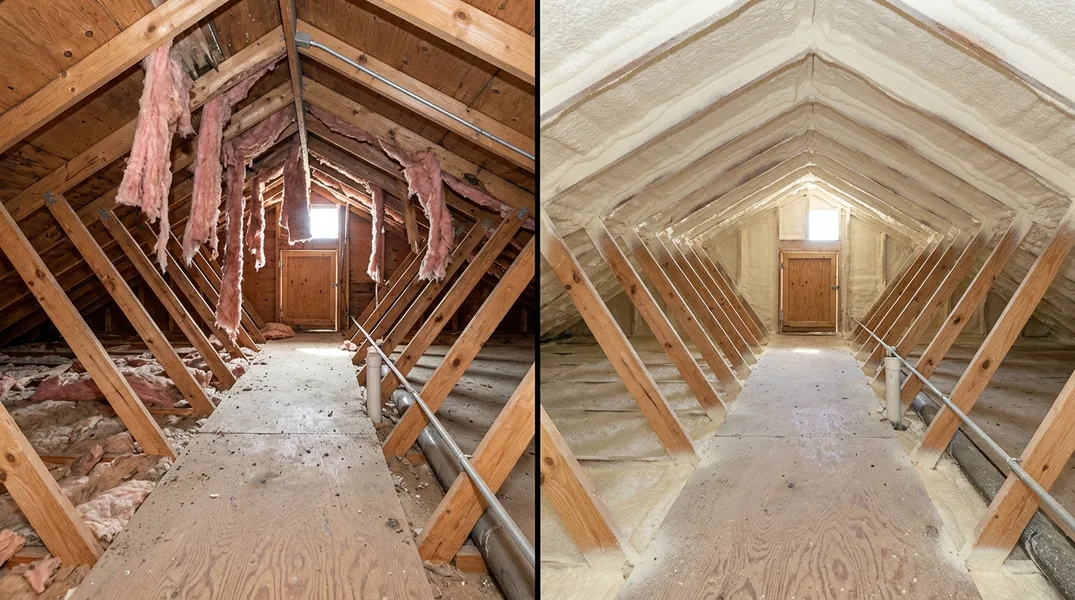
Understanding R-Value Requirements for Lincoln Homeowners
If you're a homeowner in Lincoln, understanding insulation R-value is the first step in deciding whether to top up your existing insulation or invest in a complete spray foam retrofit. R-value measures thermal resistance, and higher numbers mean better insulation performance. Nebraska's climate demands serious attention to attic insulation because winters are cold and summers can be humid, both of which stress an inadequately insulated attic.
The spray foam insulation R value per inch varies depending on the type of foam used. Closed Cell Spray Foam Insulation delivers approximately 6.0 to 6.5 R-value per inch, making it highly efficient for smaller spaces. Open Cell Spray Foam Insulation, by contrast, provides about 3.5 to 3.6 R-value per inch but is less expensive and still performs well in most attic applications. Understanding these differences helps you make an informed choice about whether topping up with traditional batts or blown-in insulation makes sense, or whether a full foam conversion is the better investment.
R-Value Requirements by State: What Nebraska Expects
Nebraska's building codes and energy efficiency standards specify minimum insulation levels for residential attics. For most of the state, including Lincoln, the recommended R-value for attic insulation is R-38 to R-49, depending on your heating and cooling system type. This translates to roughly 12 to 15 inches of traditional fiberglass batts or about 6 to 8 inches of closed-cell spray foam. The R value requirements by state are driven by the International Energy Conservation Code (IECC), which Nebraska has largely adopted, though local amendments may apply.
Many older homes in Lincoln fall well short of these standards, with attics insulated to only R-19 or R-25. If your home was built before 2000, your attic is almost certainly underinsulated by today's standards. This gap between what you have and what's recommended is where the air sealing versus full foam decision becomes critical. A professional energy audit can reveal your current R-value and help determine the most cost-effective path forward.
Air Sealing Alone: When It's Enough to Top Up
Air sealing is the process of identifying and closing gaps, cracks, and penetrations in your attic that allow conditioned air to escape. Before adding any new insulation, air sealing should be your first priority because even the best insulation performs poorly if air is leaking around it. Common problem areas include gaps around electrical boxes, plumbing vents, HVAC ducts, and the attic hatch. A thorough air sealing job can reduce energy loss by 10 to 20 percent on its own.
If your attic already has R-25 to R-35 of insulation and you simply want to reach the recommended R-38 to R-49, air sealing combined with topping up using traditional blown-in cellulose or fiberglass may be sufficient and more affordable than a full spray foam conversion. This approach makes sense if your budget is tight and your existing insulation is in good condition (not compressed, wet, or heavily settled). You'll seal all the air leaks, then add 4 to 6 inches of blown-in material on top. The total project cost is usually 40 to 60 percent less than full foam installation.
When Full Attic Spray Foam Insulation Makes Financial Sense
Attic Spray Foam Insulation becomes the better choice when your current insulation is damaged, inadequate, or when air sealing alone won't solve your comfort or energy problems. Spray foam provides superior air sealing and insulation in one application, eliminating the need for separate air sealing work. It also creates a vapor barrier in closed-cell applications, protecting your attic from moisture damage, which is particularly valuable in climates with seasonal humidity swings like Nebraska experiences.
Full foam is also worth considering if you plan to stay in your home for 15 or more years. Although the upfront pricing is higher (typically $1,500 to $3,500 for an average attic), the energy savings accumulate over time. Homeowners report 15 to 30 percent reductions in heating and cooling costs, depending on the size of the attic and the current state of the home's envelope. Additionally, spray foam can add structural rigidity to your attic and may allow you to convert attic space into usable storage or living area, which increases home value.
How Thick Should Spray Foam Be: Sizing Your Application
The question of how thick should spray foam be depends on your R-value target and the type of foam selected. For Closed Cell Spray Foam Insulation, achieving R-38 requires approximately 6 to 6.5 inches of material. To reach R-49, you'll need about 8 inches. Open-cell foam requires roughly 10 to 11 inches to reach R-38 and 14 to 15 inches for R-49. Most attics in Lincoln benefit from closed-cell spray foam because it provides superior performance in a thinner application, leaving more usable attic space.
Thickness also matters for vapor control and moisture management. Closed-cell foam acts as an air and vapor barrier, which is essential in attics where warm, moist air from living spaces below can condense during cold months. Open-cell foam is vapor-permeable, which some builders prefer in certain climates, but Nebraska's cold winters and variable humidity levels generally favor closed-cell applications. A professional contractor will evaluate your specific attic conditions and recommend the appropriate thickness and foam type to meet Nebraska's energy codes and your home's unique needs.
Rebates: Don't Leave Money on the Table
One significant advantage of investing in spray foam or other energy-efficient insulation upgrades is the potential for financial incentives. The federal insulation tax credit ended on December 31, 2025, so ask your utility company about any current rebates instead. For a $2,500 spray foam project, this could mean a $750 credit. Nebraska also offers various insulation rebates through utility companies and state energy programs, which can further reduce your out-of-pocket cost.
To qualify for these incentives, the work must typically be performed by a licensed contractor and meet specific energy code standards. Lincoln Spray Foam Insulation can help ensure your project qualifies for available credits and rebates. We recommend contacting your local utility provider and checking the ENERGY STAR website for current programs. When you factor in these incentives, the true cost of a full spray foam conversion often drops significantly, making it competitive with or cheaper than multiple rounds of blown-in insulation upgrades over the life of your home. Reach out to us at (531) 229-1733 for a free estimate that includes information about available incentives for your specific situation.
Attic Spray Foam Insulation Near Me: When to Call a Professional
Deciding between air sealing and full spray foam isn't always straightforward, which is why consulting a professional is valuable. A qualified contractor can perform a blower door test to measure air leakage, use thermal imaging to identify problem areas, and calculate the exact R-value needed based on your attic's current condition and your home's age and construction type. This diagnostic approach takes the guesswork out of the decision and ensures you invest in the right solution for your home.
If you're in Lincoln and considering whether to top up your attic insulation or go with a complete spray foam solution, Lincoln Spray Foam Insulation is here to help. We serve the entire Lincoln area with expert installation of Attic Spray Foam Insulation and can guide you through the decision-making process with confidence. Contact us today at (531) 229-1733 or request a free estimate to learn which approach will deliver the best return on your investment and keep your home comfortable year-round.
Looking for a professional spray foam insulation contractor in Lincoln? Lincoln Spray Foam Insulation responds fast for all your spray foam insulation needs.
Get a Free Quote