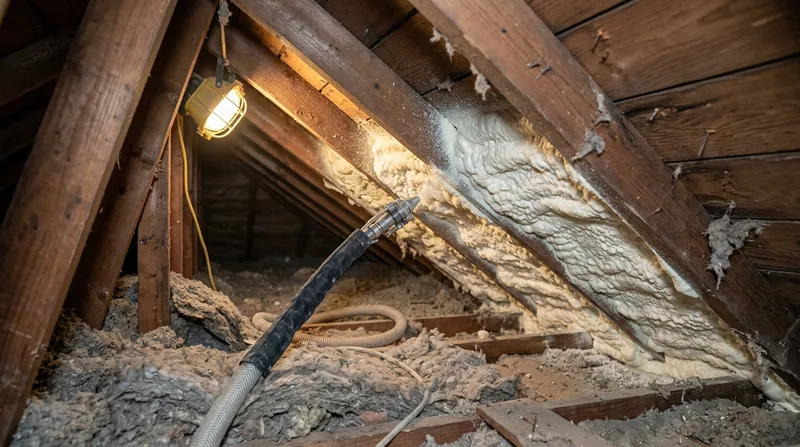




Lincoln's rental properties and mid-century homes often carry years of compressed, damaged, or missing insulation after decades of turnover and seasonal swings. Old fiberglass batts settle and separate, blown-in cellulose packs down to half its original R-value, and foam that was never installed to code leaves rim joists and attic cavities exposed to Nebraska's cold winters and humid summers. Insulation replacement and re-insulation pulls out the failed material and installs spray foam suited to your home's actual use and climate zone. We remove the old insulation, seal air leaks, and spray fresh closed cell or open cell foam to the specifications your home needs. The result is better moisture control, stable R-value over time, and lower heating and cooling costs through Lancaster County.
Why Insulation Replacement Matters in Lincoln's Older Housing Stock
Lincoln's Near South, Country Club, and Havelock neighborhoods were built with insulation standards that no longer meet energy code or real-world performance. Rental properties near the University of Nebraska see the worst wear: tenants turn over every year or two, maintenance gets deferred, and old insulation compresses under its own weight or gets damaged during repairs. Mid-century ranches scattered through Lancaster County often have single-layer fiberglass or no attic insulation at all. Basements with rim joists stay cold and damp through winter, then pick up moisture again after summer storms. When you replace failed insulation with spray foam, you're not just adding R-value; you're sealing the air leaks that make heating and cooling inefficient.
- We remove compressed or damaged batts, blown-in cellulose, and old foam that no longer performs to code.
- We seal air leaks around rim joists, band joists, electrical outlets, and ductwork before spraying new insulation.
- We install closed cell or open cell spray foam at the thickness and density your attic, wall, or crawl space actually needs.
- We follow manufacturer specifications for drum temperature, mixing ratio, and pass thickness so the foam cures properly and holds its R-value.
- We provide mechanical ventilation during cure and observe a re-entry window of 24 to 48 hours before occupancy resumes.
Removing failed insulation and installing spray foam is the only way to restore the thermal and moisture performance your home lost over decades of use.
Key info: Lincoln's building code requires insulation to meet minimum R-values for attics (typically R-38 to R-49 in zone 5A), walls (R-13 to R-21), and basements (R-10 to R-15). Old homes often fall short. Your local building department in Lincoln, Waverly, or Eagle can tell you what code applies at your address and whether a permit is required for your replacement job. Always check before you hire.
For guidance on what applies at your address, visit the City of Lincoln Building and Safety Division or contact your city's building department directly.
How We Remove Old Insulation and Install Spray Foam in Lincoln
Replacement insulation starts with removal. We bring in a commercial vacuum system to pull out old batts, cellulose, or failed foam without scattering dust and debris through your home. Once the cavity is clean, we inspect for moisture damage, rodent droppings, or mold; if we find active moisture or contamination, we walk away and refer you to the licensed professional who handles that trade. If the substrate is dry and sound, we seal air leaks with caulk or foam backer rod, then spray closed cell or open cell foam to the thickness and R-value your home needs. We do not spray over wet cavities or leaking roofs. We fix the moisture first or we walk away.
- We inspect the cavity and confirm the substrate is dry before we spray any foam.
- We caulk penetrations, rim joist edges, and band joist seams to block air leaks before insulation goes in.
- We measure and record the thickness of each pass so the foam builds to the specified R-value without over-application.
- We set up mechanical ventilation during cure and post a re-entry notice on the door.
- We provide a written estimate showing R-value, thickness in inches, and the closed cell or open cell choice suited to your use.
Our approach to insulation removal and replacement is methodical and documented so you know exactly what was removed, what went in, and why.
Real example: A rental property in the Havelock neighborhood had three inches of compressed fiberglass in the attic and a 12-inch rim joist with no insulation at all. We removed the old batts, sealed the rim joist seams, sprayed two inches of closed cell foam in the rim joist to R-13, and topped the attic with open cell foam to R-38. The owner saw a 22 percent drop in winter heating costs and zero ice dam problems the next winter.
Replacement Insulation Methods for Lincoln Homes and Rental Properties
| Approach | Description | Best for |
|---|---|---|
| Attic replacement with open cell foam | Remove old batts or cellulose, spray 5 to 6 inches of open cell foam to R-30 to R-38. Allows attic ventilation and vapor diffusion. | Vented attics in mid-century homes where cost matters and moisture control is secondary to insulation value. |
| Sealed attic with closed cell foam | Remove old material, spray 2 to 3 inches of closed cell foam on the roof deck, creating an unvented sealed attic with R-13 to R-19 per inch. | Newer homes or retrofits where moisture control and air sealing are priorities, and HVAC ducts run in the attic. |
| Rim joist and band joist replacement | Remove old fiberglass or nothing, seal rim joist seams with caulk, spray 2 inches of closed cell foam to R-13 and block air infiltration. | All basements in Lincoln, especially older homes where the rim joist has no insulation and drives up winter heating bills. |
| Wall cavity injection foam retrofit | Drill holes in the exterior sheathing or interior drywall, inject closed cell foam into wall cavities without demolition. Fills voids and seals air leaks. | Pre-1980 homes with empty or poorly insulated walls where removing drywall or siding is not feasible. |
| Crawl space replacement | Remove old batts or cellulose, spray closed cell foam on the crawl space band joist and rim, then on the rim perimeter to seal moisture and air entry. | Crawl spaces with no insulation or failed batts, especially in Ceresco, Hickman, and Eagle where moisture swings are severe. |
Each approach removes the old material and installs spray foam matched to your home's use, climate exposure, and moisture profile. We choose closed cell for moisture-critical zones like rim joists and sealed attics; we choose open cell for vented attics where cost and breathability matter more.
Insulation Replacement & Re-Insulation Cost in Lincoln: What to Expect
Replacement insulation costs depend on the area to be insulated, the type of old material being removed, access to the cavity, and whether you choose closed cell or open cell foam. A typical attic replacement in a mid-sized Lincoln home runs starting at $2,800 and can reach $6,000 to $8,000 for a full attic plus rim joist work. Rim joist-only projects often start at $1,200 to $1,800. Wall injection foam retrofits in older homes run $3,500 to $5,500 depending on the number of cavities and how many holes we need to drill. Crawl space replacement is typically $2,000 to $4,000.
The biggest cost driver is the area being insulated. A 1,500-square-foot attic costs more than a 900-square-foot attic. Old material that is loose and easy to remove costs less in labor than material that is packed tight or glued down. Access matters too; an attic with good stairs and open rafter bays is faster than a cramped space with trusses and limited headroom. Choosing closed cell foam costs more per board foot than open cell, but closed cell delivers higher R-value per inch and better moisture performance in damp zones like rim joists and sealed attics.
The only way to get an accurate price for your home is a free on-site estimate. We measure the area, inspect the existing insulation and substrate, and provide a written quote showing R-value, thickness, square footage, and the total cost. We respond within 24 hours and never charge for the estimate. Call (531) 229-1733 or visit our pricing page for more detail on how we structure costs and what moves a quote up or down.
What to Look for When Hiring a Spray Foam Insulation Contractor Near Me in Lincoln
Choosing the right contractor for insulation replacement is about more than price. You are inviting someone into your home to remove old material, spray a chemical product that requires ventilation during cure, and leave your home uninhabitable for 24 to 48 hours. The wrong choice can leave you with poor foam adhesion, off-ratio mixing, inadequate ventilation, and a smell that lingers for weeks. The right choice is a local contractor who shows up with a clean rig, pulls a permit if your city requires one, and documents every step.
Look for a contractor who provides a written estimate with R-value, thickness in inches, and the closed cell or open cell choice explained. Avoid any estimate that lists only a price per board foot or per square foot with no detail on what you are actually getting. Ask for references from recent jobs in your neighborhood. Confirm that the contractor is fully insured and carries liability coverage; ask for a certificate of insurance before any work starts. Check with your local building department to see if a permit is required for your job; if it is, hire only a contractor who will pull it and pass inspection. If your home is in a master-planned community with HOA rules, confirm that exterior work is approved before you sign.
- Request a written estimate that breaks down R-value, thickness, material type, and total square footage.
- Call at least two other contractors and compare their recommendations, not just their prices.
- Ask for three references from recent jobs and call them to ask about quality, smell, and re-entry experience.
- Confirm the contractor carries full insurance and will provide a certificate before work starts.
- Check your city's building department website to see if a permit is required and whether the contractor will pull it.
- Avoid any contractor who promises immediate re-entry or makes absolute safety claims.
A local contractor with a local address, local plates, and a track record in Lincoln and surrounding areas is your best hedge against rig-and-run crews or national franchises that disappear when the smell will not go away. For a free estimate from a contractor who has been serving Lancaster County since 2012, contact us today.
Insulation Replacement & Re-Insulation in Lincoln: Pricing Guide
| Service | Price | Details |
|---|---|---|
| Attic replacement with open cell foam | Starting at $2,800 | Removal of old batts or cellulose, sealing rim joist seams, spray to R-30 to R-38. Cost varies with attic size and access difficulty. |
| Rim joist and band joist replacement | Starting at $1,200 | Removal of old fiberglass or nothing, caulking seams, closed cell spray to R-13. Price depends on linear feet of rim joist exposed. |
| Wall cavity injection foam retrofit | Starting at $3,500 | Drilling and injection of closed cell foam into cavities without demolition. Cost scales with number of cavities and wall area. |
| Crawl space replacement | Starting at $2,000 | Removal of old batts, closed cell spray on band joist and rim perimeter to seal moisture and air entry. Price depends on crawl space size. |
| Full-home replacement or complex scope | On estimate | Attic, rim joist, walls, and crawl space in one project require on-site inspection and measurement before a firm price can be quoted. |
| Estimate and travel | Free | No obligation, response within 24 hours, included in Lincoln and surrounding areas. Call (531) 229-1733 to schedule. |
Indicative pricing, the exact cost depends on square footage, finish, and site access. Free personalized estimate within 24h at (531) 229-1733.


