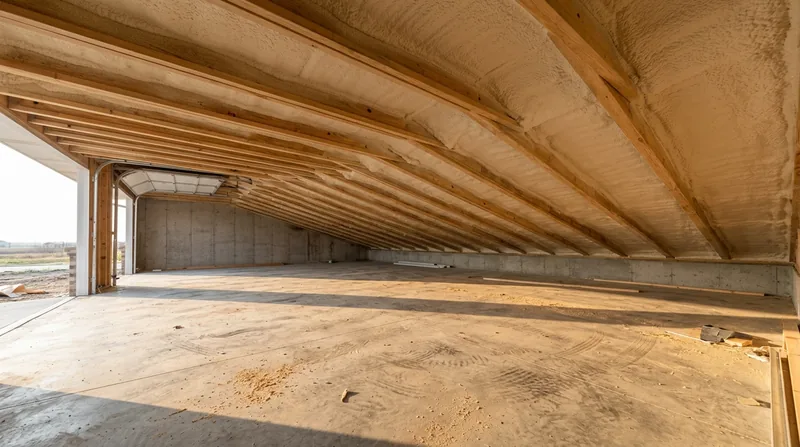




Rooms built over garages lose heat fast through that shared wall during Lincoln's cold winters. We spray foam the garage ceiling and shared walls to stop that transfer in homes across Lancaster County. Garage spray foam insulation in Lincoln is one of the most cost-effective ways to reclaim comfort in those spaces and cut the heating load on your furnace. Whether you're warming a detached garage, insulating the rim joist where it meets the garage framing, or sealing the wall between a living room and an unheated garage below, spray foam closes the air leaks and thermal gaps that fiberglass batts and blown-in cellulose simply cannot reach. The winters here are long and windy, and the spring thaw brings moisture into basements and band joists from both above and below. A properly sealed and insulated garage ceiling stops that cold transfer before it starts, and it keeps the room above livable without running the heating system overtime.
Why Garage Spray Foam Insulation Matters in Lincoln's Climate
Lincoln's housing stock spans everything from Havelock bungalows built in the 1920s to mid-century ranches scattered through the neighborhoods and newer subdivisions rising on the south and east edges of town. Nearly every home sits over a basement, and almost all have garages, either attached or detached. The shared wall between a heated room and an unheated garage is a thermal weak point year-round. In winter, the cold from the garage pulls heat through drywall, studs, and any insulation that has settled or failed. In summer, the heat that builds up in an unventilated garage can push into the room above or beside it, forcing your air conditioning to work harder. Spray foam seals both the thermal boundary and the air leaks that fiberglass cannot reach.
- We seal the rim joist where the garage meets the main house framing, stopping the biggest air leak in most garages.
- We insulate the ceiling above the garage to R-21 or higher, depending on your needs and local code.
- We close the shared wall between the garage and any heated living space above or beside it.
- We apply mechanical ventilation during the spray to ensure safe cure and a clean re-entry after 24 to 48 hours.
These four steps together stop the heat loss that drives up your winter gas bill and the heat gain that pushes up summer cooling costs across Lancaster County.
Key info: A garage ceiling without insulation can lose 40 to 60 percent of the heat from the room above it during a cold night. A single pass of closed cell spray foam at 1.5 inches reaches R-9, and a second pass pushes it to R-18 or higher. The difference shows up on your heating bill within the first month of cold weather.
The City of Lincoln building code and the Nebraska Energy Code both govern insulation R-values and thermal barriers for garage spaces. Before we start, we confirm what applies at your address. More detail is available from the Lincoln Planning and Zoning Department, which administers the energy and building codes for residential work in the city.
How We Insulate and Seal Garage Spaces in Lincoln
The job starts with a walk-through to understand the garage layout, the condition of any existing insulation, and whether the ceiling or walls are wet, contaminated, or leaking. If we find active moisture or a roof leak, we stop and walk away. Spray foam sticks only to dry, clean surfaces, and applying it over a wet substrate is a recipe for failure and mold. Once we confirm the space is ready, we measure the square footage, calculate the board feet needed for your target R-value, and give you a written estimate that spells out the thickness, the number of passes, and the final R-value you will receive.
- We set up temporary containment to keep overspray off cars, tools, and stored items in the garage.
- We apply closed cell or open cell foam in controlled passes, checking thickness and ratio on every drum.
- We run mechanical ventilation during the spray and for the full cure window, typically 24 to 48 hours.
- We trim back any excess foam and install the thermal barrier required by code (usually drywall or intumescent paint).
- We walk you through the re-entry window and answer any questions about the cured foam and the performance you should expect.
The whole process is transparent and measured. You get a written estimate before we start, and you know exactly what R-value and thickness you are paying for.
Local example: A homeowner in the Havelock neighborhood had an attached garage with a 12 by 16 ceiling and a shared wall into the master bedroom. The old fiberglass batts had compressed and settled, leaving gaps and thermal bridges. We sprayed 2 inches of closed cell foam on the ceiling and 1.5 inches on the shared wall. The bedroom stayed warm all winter without extra heating, and the homeowner noticed the difference in the first gas bill.
For homes with more complex layouts, such as garages with vaulted ceilings or metal building garages out in the county, we also offer metal building and barndominium spray foam insulation, which handles the condensation control and thermal performance that metal structures demand.
Garage Spray Foam Insulation Methods: Closed Cell vs. Open Cell
| Approach | Description | Best for |
|---|---|---|
| Closed Cell Spray Foam | Dense, rigid foam at 1.5 to 2 inches per pass. R-value of 6 to 7 per inch. Vapor barrier. Low moisture absorption. | Garage ceilings, rim joists, shared walls, and any space where moisture or air infiltration is a concern. |
| Open Cell Spray Foam | Softer, lighter foam at 3 to 5 inches per pass. R-value of 3.6 per inch. Vapor permeable. Sound dampening. | Attics and interior walls where sound control matters and moisture is not a primary concern. |
| Rim Joist and Band Joist Sealing | Closed cell foam applied to the concrete rim, the band joist, and the sill plate. Stops air leakage and moisture intrusion at the foundation. | Any garage with a basement or crawl space below. Addresses the biggest thermal and moisture leak in most homes. |
| Existing Insulation Removal and Replacement | We remove failed batts, loose fill, or old foam, dispose of it properly, and spray new foam to your target R-value. | Garages with compressed, wet, or moldy insulation that cannot be salvaged or topped up. |
For most garages in Lincoln, closed cell spray foam is the right choice. It reaches high R-values in thin layers, stops air leaks completely, and resists moisture from the basement or ground below. Open cell foam is less common in garage work because it absorbs moisture and does not create a vapor barrier. If you have questions about which method fits your space, call us at (531) 229-1733 and we will walk you through the trade-offs during your free estimate.
Garage Spray Foam Insulation Cost in Lincoln: What to Expect
Garage spray foam insulation in Lincoln starts at $1,200 for a small attached garage ceiling with straightforward access. The final price depends on several concrete factors. A larger garage, a vaulted or cathedral ceiling, shared walls that need insulation, or a rim joist that requires sealing will all add to the board footage and the labor. If the space has wet insulation that must be removed first, or if the garage is detached and sits far from the house, access and setup time increase the cost. The only way to know the exact price for your job is to get a site visit and a written estimate that spells out the square footage, the board feet, the thickness, and the final R-value.
- Small attached garage ceiling, no removal, straightforward access: starting around $1,200 to $1,800.
- Larger garage, shared walls, or rim joist sealing: typically $2,000 to $3,500 depending on layout and existing insulation.
- Detached garage, removal of old insulation, or complex framing: on estimate after a site visit.
- Travel to your address in Lincoln and surrounding areas is included in our estimate, with no separate mileage fee.
We always provide a free estimate. Call (531) 229-1733 and we will respond within 24 hours to schedule a walk-through. There is no obligation to book. Once we see the space and understand your goals, we give you a written estimate with all the details you need to make a decision. We recommend getting 2 to 3 estimates from different contractors so you can compare not just price, but R-value, thickness, warranty, and the contractor's willingness to answer your questions. For more detail on our pricing structure and what factors move the estimate up or down, visit our full pricing overview.
What to Look for When Hiring a Spray Foam Insulation Contractor Near Lincoln
Not all spray foam work is equal. The difference between a professional installation and a poor one shows up in the first month of cold weather, or it hides until a smell develops months later. When you are looking for a contractor near Lincoln to insulate your garage, ask specific questions and verify the answers. A good contractor will give you a written estimate with R-value and thickness spelled out. A bad one will quote a vague price per square foot with no mention of what you are actually getting. A good contractor will confirm that permits apply at your address and will help you navigate what the local building department requires. A bad one will say permits are not necessary or will promise to handle them without actually pulling them.
- Ask the contractor whether they are fully insured and request a certificate of insurance to verify coverage.
- Get a written estimate that includes the square footage, board feet, foam type, thickness per pass, and final R-value.
- Ask whether the contractor will run mechanical ventilation during the spray and for the full cure window, and what the re-entry window is.
- Check references from recent jobs in Lincoln and ask those homeowners whether the smell was manageable and whether the performance matched the estimate.
- Confirm that the contractor understands local building code and will help you verify what permits and thermal barriers apply at your address.
- Ask whether the contractor has experience with your specific garage layout, whether it is attached, detached, vaulted, or built over a basement or crawl space.
If you are ready to move forward, contact us for a free estimate. We have been in business since 2012, we are fully insured, and we give you a written estimate with all the details before we spray a drop of foam. We also serve Waverly, Hickman, Eagle, Ceresco, Crete, Milford, Ashland, Seward, Wahoo, Beatrice, Gretna, Papillion, La Vista, Bellevue, Omaha, Fremont, Nebraska City, Plattsmouth, and David City, so if you are just outside Lincoln, call us anyway.
Garage Spray Foam Insulation in Lincoln: Pricing Guide
| Service | Price | Details |
|---|---|---|
| Small attached garage ceiling | Starting at $1,200 | Straightforward ceiling insulation, no removal, standard access, R-21 closed cell or equivalent |
| Medium garage with shared walls or rim joist | Starting at $2,000 | Larger footprint, shared wall sealing, rim joist band joist work, removal of failed batts if present |
| Detached garage, complex layout, or removal and replacement | On estimate | Vaulted ceilings, multiple walls, significant old insulation removal, or difficult access require site measurement |
| Travel and mobilization | Included | No separate mileage fee or travel charge within Lincoln and surrounding Lancaster County service area |
| Free written estimate | No charge | 24-hour response window, on-site measurement, R-value and thickness specifications, no obligation to book |
Indicative pricing, the exact cost depends on square footage, finish, and site access. Free personalized estimate within 24h at (531) 229-1733.


