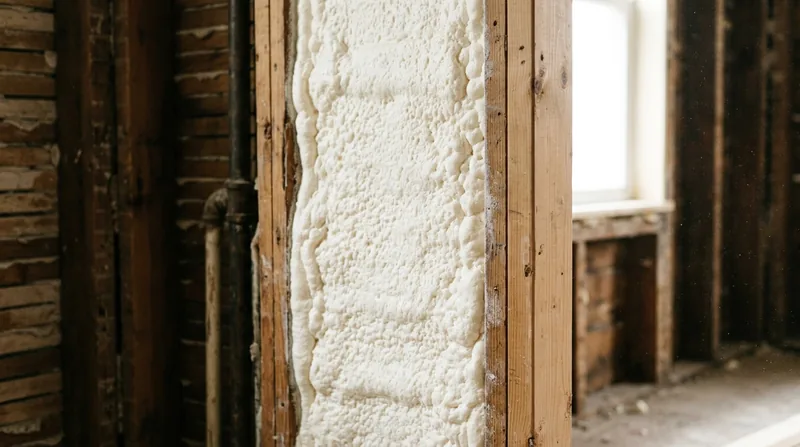




Open cell spray foam insulation in Lincoln fills the stud bays and attic rafter spaces in the older homes of the Near South, Country Club, and Havelock neighborhoods, sealing air leaks that pull heated air out through walls during Nebraska's dry, windy winters. Lincoln's housing stock spans a century, from turn-of-the-century bungalows to mid-century ranches and newer subdivisions on the south and east edges of town, and nearly every home sits over a full basement where rim joists and band joists stay cold and damp through the heating season. Open cell foam expands to fill every gap in wall cavities and attic rafter bays, stopping the draft that drives up winter heating bills and the moisture swings that damage framing in humid summers. The product is lighter, less dense, and more affordable than closed cell foam, making it the right choice for many attic and wall retrofit jobs across Lancaster County. We help homeowners and builders in Lincoln and the surrounding areas understand which foam type matches their space, their climate challenge, and their budget, and we install it to the manufacturer's specifications with mechanical ventilation and a stated re-entry window. Call us at (531) 229-1733 for a free, written estimate with R-value and thickness specs, or learn more about our attic spray foam insulation services.
Why Open Cell Spray Foam Matters in Lincoln's Older Neighborhoods
Lincoln's Near South and Country Club homes were built in an era when air sealing was not a concern, and their walls and attics leak cold air in winter and allow hot air to migrate through in summer. The city's IECC climate zone 5A brings dry winters that pull moisture out of wall cavities, then humid summers that push moisture back in from outside, creating vapor drive in both directions across the heating and cooling seasons. Fiberglass batts and blown-in cellulose settle over time, leaving gaps at the rim joist and top plate where the wood frame meets the foundation or the roof. Open cell foam expands to fill those gaps permanently, and its open-cell structure allows some moisture vapor to move through the foam, which is the right choice for walls and attics in this climate where the moisture load swings seasonally.
- Open cell foam seals air leaks that fiberglass batts cannot reach, stopping drafts at the rim joist, top plate, and around electrical boxes and penetrations.
- The material expands to fill every cavity in a single pass, conforming to irregular framing and blocking thermal bridging through wood studs.
- In Lincoln's dry winter air, open cell foam prevents the moisture that would otherwise be pulled out of wall cavities by the heating cycle.
- The lower density and lower cost make open cell foam the practical choice for attic and wall retrofit jobs across older residential neighborhoods.
- Mechanical ventilation during cure and a twenty-four to forty-eight hour re-entry window protect your family and ensure the installation meets code.
These advantages make open cell foam a proven solution for the heating and cooling challenges that dominate older homes across Lincoln and Lancaster County.
Key info: Lincoln's older neighborhoods, from the 1920s bungalows near Pioneers Park to the 1950s ranches in Havelock, lose heat and gain heat through walls and attic rafter bays because the original insulation has settled or failed. Open cell foam fills those cavities and stops the air leaks that fiberglass batts leave behind, lowering winter heating costs and summer cooling costs in homes across the Near South, Highlands, and Country Club districts.
For more detail on how foam works in attics, see our attic spray foam insulation page, or learn about closed cell spray foam insulation if your project involves condensation control on metal or a rim joist that sits in a damp crawl space.
How We Install Open Cell Spray Foam Insulation in Lincoln Homes
Our process begins with a site inspection to identify the scope of work, the substrate condition, and the air leaks that are costing you money. We prepare the space by sealing off HVAC returns and supply ducts, ensuring that the spray area is isolated from living spaces, and setting up mechanical ventilation to run during the cure period and for the full re-entry window. We measure the cavity depth and width, calculate the board feet needed, and arrive with equipment calibrated to the manufacturer's specifications for drum temperature and material ratio. Once we spray, the foam rises and expands to fill every gap in the wall cavity or attic rafter bay, and we shave it flush with the framing so that drywall or ceiling material can be installed over it without gaps.
- We inspect the substrate for moisture, leaks, or contamination and walk away if the space is not dry or if repairs must come first.
- We isolate HVAC ducts and living spaces with temporary barriers and set up mechanical ventilation for the full cure period.
- We spray open cell foam at the manufacturer's specified ratio and temperature, filling cavities to the correct thickness in a single controlled pass.
- We shave the foam flush with the framing so that drywall, ceiling material, or roof sheathing can be installed without voids or compression.
- We provide a written estimate with R-value and thickness specs before any work begins, and we schedule the job when weather and site conditions are favorable.
This controlled, methodical approach is what separates a professional installation from a quick spray-and-leave job that leaves you with smell, incomplete fill, or callbacks weeks later.
Example: A 1950s ranch in Havelock with a vented attic and original fiberglass batts that have settled to R-8 in many bays. We inspect the attic, verify that the roof deck is dry and the ridge vent is clear, and spray open cell foam to R-19 across the entire rafter bay. The homeowner gains air sealing at the eaves and gable ends, and the attic stays vented as the code requires. The job takes one day, and the re-entry window is forty-eight hours.
Learn more about our air sealing services and how we seal the specific air leaks that are costing you the most money.
Open Cell vs. Closed Cell Spray Foam: When to Use Each
| Approach | Description | Best for |
|---|---|---|
| Open Cell Foam | Lower density (0.5 to 2 lbs/cu ft), expands to fill cavities, allows moisture vapor to move through the material, lower R-value per inch (R-3.5 to R-4.2 per inch), less expensive per board foot. | Attic rafters, wall cavities, sound dampening in garages, retrofit jobs where budget and access are constraints, climates with seasonal moisture swings like Lincoln. |
| Closed Cell Foam | Higher density (2 to 3.5 lbs/cu ft), does not allow moisture vapor to pass through, higher R-value per inch (R-6 to R-7 per inch), creates a vapor barrier, more expensive per board foot. | Rim joists in damp crawl spaces, metal building condensation control, sealed attic decks, new construction walls, areas where moisture control is the primary concern. |
| Blown-In Cellulose or Fiberglass | Loose fill, settles over time, leaves gaps at the rim joist and top plate, no air sealing around penetrations, lowest cost per R-value, but does not create a continuous thermal barrier. | Top-up of sound attics where the substrate is dry and settled fiberglass can be removed, budget-conscious homeowners who accept some air leakage, new construction where the framing is tight and the air leaks are minimal. |
| Spray Foam Removal and Replacement | Removal of failed, over-sprayed, or contaminated foam, followed by inspection of the substrate and installation of new foam at the correct thickness and R-value. | Attics and walls where previous spray foam was installed incorrectly, homes where the foam has absorbed moisture or developed odor, retrofits that require a fresh start. |
Open cell foam is the right choice for most attic and wall retrofit jobs in Lincoln because it seals air leaks, allows the wall to dry if moisture enters from either direction, and costs less than closed cell. Closed cell is the answer when you are insulating a rim joist in a damp crawl space or when you need the vapor barrier and high R-value of a condensation control system. Let us help you choose the right foam type for your space and your climate.
Open Cell Spray Foam Insulation Cost in Lincoln: What to Expect
Open cell spray foam insulation pricing in Lincoln starts at approximately $0.55 per board foot, though the final cost depends on several factors specific to your home and the scope of work. A typical attic retrofit in a 1,500 square foot ranch in Havelock might run between $1,500 and $3,500, depending on the rafter bay depth, the R-value target, and the complexity of the air sealing work around the eaves and gable ends. Wall retrofit jobs in older homes near the University of Nebraska or the Near South neighborhoods often cost more because the walls are thicker, the cavities are irregular, or the work requires temporary bracing of exterior walls. The cost per board foot can shift based on access to the work area, the condition of the substrate, whether existing insulation must be removed first, and the distance from our shop to your address.
Getting two or three written estimates from different contractors is the smartest way to understand what the market rate is for your specific job. A professional estimate should include the R-value, the thickness of the foam, the board feet being installed, the cost per board foot, and any labor or travel charges. Estimates that omit the R-value or thickness, or that quote a price far below the market rate with no inspection, are a red flag. We provide a free, written estimate within twenty-four hours, with all the technical specs and a breakdown of the work, so you can compare our price and our approach to other contractors in the Lincoln area.
Visit our pricing page for more detail on what drives the cost of your specific job, or call (531) 229-1733 to schedule a free estimate today.
What to Look for When Hiring a Spray Foam Insulation Contractor Near Me in Lincoln
Hiring a spray foam contractor is a significant decision, and it is worth taking the time to verify that the person or company you choose has the experience, the insurance, and the professional approach to do the job right. The spray foam trade includes everything from careful local shops that have served Lincoln for over a decade to rig-and-run crews that arrive in an out-of-state trailer, spray a job in an afternoon, and disappear when the smell or the incomplete fill becomes a problem. You should ask any contractor whether they are fully insured, request a copy of their certificate of insurance, and verify that the coverage includes spray foam work. You should also ask about permits, because attic ventilation, ignition barriers, and thermal barriers are governed by the energy and building code in force at your address, and the local building official has the final say on what is required. HOA rules in some master-planned areas may also restrict exterior work on metal buildings or require architectural approval, so it is worth checking before you book.
- Verify that the contractor is fully insured and ask to see the certificate of insurance, which should name spray foam work specifically.
- Get multiple written estimates that include the R-value, thickness, board feet, and cost per board foot, so you can compare apples to apples.
- Ask for references from recent jobs in Lincoln or nearby areas, and call at least two to ask about the quality of the work and whether the contractor was responsive after the job was done.
- Understand what permits are required at your address by calling the City of Lincoln Building Department or your local city office, and confirm that your contractor knows what applies to your job.
- Ask about the re-entry window, the ventilation plan during cure, and whether the estimate includes a written warranty on the workmanship and the installation.
A professional contractor will answer every one of these questions clearly, provide a written estimate with all the technical specs, and be willing to walk away from a job if the substrate is wet, contaminated, or if repairs must come first. That willingness to say no is the mark of a contractor who cares about the quality of the installation and your satisfaction after the job is done.
Ready to move forward? Contact us today for your free estimate, or call (531) 229-1733 to speak with one of our team members about your specific project.
Open Cell Spray Foam Insulation in Lincoln: Pricing Guide
| Service | Price | Details |
|---|---|---|
| Open Cell Spray Foam, Attic | Starting at $0.55/board ft | R-19 to R-21 across rafters, includes air sealing at eaves and gable ends, cost rises with rafter depth and attic complexity |
| Open Cell Spray Foam, Wall Retrofit | Starting at $0.55/board ft | 2x4 or 2x6 stud bays, older homes Near South and Country Club, price reflects wall height and access constraints |
| Garage Wall or Ceiling | Starting at $0.60/board ft | Sound dampening and thermal control, includes sealing of rim joist if exposed, cost depends on garage size and ceiling height |
| Insulation Removal and Replacement | On estimate | Removal of failed or settled foam or fiberglass, substrate inspection, and new open cell installation requires site visit to assess volume and condition |
| Travel and Setup | Included | No separate mileage or travel charge for jobs in Lincoln and surrounding Lancaster County service areas |
| Free Written Estimate | No charge | Response within twenty-four hours, includes R-value, thickness, board feet, and cost breakdown, no obligation to book |
Indicative pricing, the exact cost depends on square footage, finish, and site access. Free personalized estimate within 24h at (531) 229-1733.


