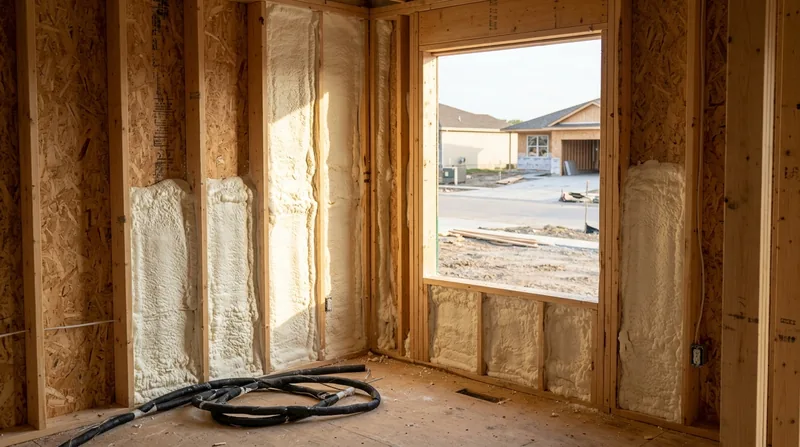




New construction in Lincoln moves fast. Builders on the south and east edges of town are raising subdivisions where commercial and new construction spray foam insulation can be installed before drywall closes the walls, capturing energy efficiency from day one. We work with general contractors, builders, and commercial property developers across Lancaster and Cass counties to foam walls, rim joists, attics, and mechanical spaces during framing. The climate here demands it: Lincoln's winters are long and windy, summers are humid, and the heating and cooling swings that follow mean every thermal break counts. Whether you are building a residential spec home in the new neighborhoods south of Highway 77, a commercial shell for retail or office space, or a mixed-use project in the urban core, spray foam seals the building envelope and cuts down on the callbacks that come with thermal bridging and air leakage after occupancy.
Why Commercial & New Construction Spray Foam Matters in Lincoln's Building Boom
Framing stage is the only time you can insulate and air-seal a wall cavity without tearing into drywall later. Spray foam fills every corner, seals around wiring and plumbing, and stops air movement that fiberglass batts cannot. In Lincoln's climate zone 5A, that sealed envelope keeps heating costs down in winter and cooling costs down in summer. Builders who skip this step or rely on batts alone end up with callback calls about cold spots, condensation on windows, and utility bills that run higher than the homeowner expected.
- Spray foam fills wall cavities completely, eliminating thermal gaps that batts leave behind.
- Air sealing during framing prevents infiltration through electrical boxes, rim joists, and band joists before drywall coverage hides them.
- Closed cell foam on rim joists resists moisture from Lincoln's humid summers and spring melt, a critical detail in basements and crawl spaces.
- Open cell foam in walls and attics costs less than closed cell and performs well in dry climates, but Lincoln's seasonal moisture swings favor closed cell for rim and band joists.
- Mechanical ventilation during cure is non-negotiable; we control application speed, drum temperature, and airflow so the foam cures properly and off-gassing stays minimal.
Getting this right at framing saves money later by avoiding retrofit work, reducing warranty callbacks, and keeping utility bills in line with energy code targets.
Key info: Lincoln's building code requires R-value and thickness specifications on all insulation work. We provide written estimates that spell out both, so your builder and the building department have no ambiguity about what goes in the wall.
For more on the technical side of air sealing, see our air sealing service page. The Lincoln Building and Safety Division publishes code requirements at the city website; always verify what applies to your address and permit type.
How We Work with Builders: Framing to Closeout
We coordinate with the general contractor and framing crew to spray walls, attics, rim joists, and mechanical chases at the right stage. Once framing is up and electrical rough-in is complete, we schedule the spray. Mechanical ventilation runs during application and cure. The crew controls thickness, pass count, and drum temperature to spec. We provide documentation with board-foot count, R-value, and thickness so your builder has the record for inspection and final closeout.
- We coordinate scheduling with your general contractor to fit spray work into the framing timeline without delaying drywall.
- Our crew applies foam to spec, with mechanical ventilation during cure and a documented re-entry window of 24 to 48 hours.
- We provide written documentation of board-foot count, R-value, and thickness for each zone so the building department has the record at inspection.
- For commercial projects, we work with your energy consultant or mechanical engineer to confirm foam type and R-value target before we spray.
- Rim joists and band joists get closed cell foam to resist moisture and provide the air seal that open cell cannot.
This approach keeps the job on schedule and gives your builder the documentation needed for permit closeout and warranty.
Example: A new subdivision going up south of Highway 77 in Lincoln called for 2x6 exterior walls with closed cell foam to R-21 for energy code compliance. We sprayed rim joists and the first floor exterior walls during framing, then the builder's crew moved to drywall. Final inspection passed without callbacks. The homeowner saw utility bills 18 percent lower than comparable homes without foam in the same subdivision.
For more on closed cell spray foam specifications and performance, visit that service page.
Spray Foam Application Methods for New Construction
| Approach | Description | Best for |
|---|---|---|
| Closed Cell Spray Foam | High-density foam (1.5 to 2 lb/cu ft) with R-value around 6 to 6.5 per inch. Resists moisture and provides structural support. Requires mechanical ventilation during cure due to isocyanate chemistry. | Rim joists, band joists, basement walls, and exterior walls in new construction where moisture control and air sealing are priorities. |
| Open Cell Spray Foam | Lower-density foam (0.5 to 1 lb/cu ft) with R-value around 3.6 per inch. Breathable, lower cost, easier cleanup. Allows some vapor movement, which suits dry climates better than humid ones. | Interior walls and attics in new construction where cost is a factor and moisture risk is low. Not recommended for rim joists or below-grade walls in Lincoln's humid climate. |
| Wall Cavity Foam (Full-Fill) | Spray foam applied to fill 2x4 or 2x6 cavities completely, eliminating thermal bridging and air gaps. Thickness is controlled to match cavity depth. | New construction exterior and interior walls where R-value targets require minimal cavity waste and maximum thermal performance. |
| Attic and Roof Deck Foam | Spray foam applied to rafter bays or the underside of roof sheathing to create a sealed, conditioned attic space. Closed cell provides moisture control; open cell is lighter and cheaper if moisture is not a concern. | New construction attics, sealed roof decks, and mechanical spaces where air sealing and R-value target the building envelope. |
| Commercial Shell Foam | Spray foam applied to exterior walls, roof decks, or mechanical spaces in commercial buildings during framing. Coordination with mechanical engineer and building code official ensures R-value and thermal barrier compliance. | New commercial construction, retail, office, and mixed-use projects where energy code compliance and air sealing are required from day one. |
Each method is chosen based on the building type, climate zone, moisture risk, and energy code target. We work with your builder or energy consultant to confirm the right approach before we spray.
Commercial & New Construction Spray Foam Cost in Lincoln: What to Expect
Pricing for spray foam in new construction depends on square footage, foam type (open or closed cell), R-value target, and site access. A free commercial estimate is the starting point. We visit the site, review the plans with your builder, and provide a written quote with board-foot estimate, R-value, and thickness for each zone. Closed cell foam costs more per board foot than open cell, but performs better in Lincoln's humid climate and saves money on callbacks and moisture issues later. Large projects and commercial shells often qualify for volume pricing.
- Closed cell spray foam typically ranges from $1.50 to $2.25 per board foot, depending on thickness and project scale.
- Open cell spray foam ranges from $0.80 to $1.20 per board foot for the same coverage and R-value targets.
- Rim joists and band joists in new construction often run $4 to $8 per linear foot, depending on depth and closed cell R-value.
- Attic and roof deck foam in new construction runs $0.80 to $1.50 per board foot for open cell, $1.50 to $2.50 for closed cell, depending on thickness and access.
- Commercial shells and large-scale jobs benefit from volume pricing and should be quoted on site after plan review.
Getting 2 to 3 estimates from different contractors is smart practice. Compare the R-value and thickness specs, not just the price. A low bid with no specs or no documentation is a red flag. Visit our full pricing overview for more detail on what moves costs up or down.
What to Look for When Hiring a Spray Foam Contractor Near Me in Lincoln
Not all spray foam contractors work the same way. A good contractor provides a written estimate with R-value and thickness specs, runs mechanical ventilation during cure, documents the work with photos and board-foot count, and is fully insured. A bad contractor shows up with a verbal estimate, promises immediate re-entry, has no ventilation setup, and is hard to reach after the job. Here is how to verify any contractor, including us.
- Ask for a written estimate that includes R-value, thickness, and board-foot count for each zone, not just a price per square foot.
- Verify that the contractor runs mechanical ventilation during application and cure, with a documented re-entry window of 24 to 48 hours.
- Check that the contractor is fully insured and can provide a certificate of insurance before work begins.
- Ask for references from at least 2 to 3 recent projects with builders or commercial clients in Lincoln or nearby.
- Confirm that the contractor understands the permitting and building code requirements at your address by asking which building department will inspect the work.
- Never accept a price far below market or a contractor who cannot explain why closed cell is better than open cell for rim joists in Lincoln's climate.
If you have questions about our work or want to discuss your new construction project, call us at (531) 229-1733 or request a free commercial estimate. We are happy to talk through the insulation package with you and your builder.
Commercial & New Construction Spray Foam in Lincoln: Pricing Guide
| Service | Price | Details |
|---|---|---|
| Free Commercial Estimate | Free | Site visit with plan review, written quote with R-value and thickness specs, no obligation to book |
| Closed Cell Spray Foam (Wall & Rim Joist) | $1.50-$2.25/board foot | Includes application, mechanical ventilation during cure, documentation with board-foot count and R-value for permit closeout |
| Open Cell Spray Foam (Attic & Interior Walls) | $0.80-$1.20/board foot | Includes application, ventilation, and documentation; lower cost than closed cell, best for dry interior spaces |
| Commercial Shell Insulation | On Estimate | Exterior walls, roof decks, and mechanical spaces; pricing depends on square footage, foam type, and site access |
| Travel & Scheduling | Included | No separate mileage fee or call-out charge in Lincoln and surrounding areas; scheduling coordinated with builder's framing timeline |
Indicative pricing, the exact cost depends on square footage, finish, and site access. Free personalized estimate within 24h at (531) 229-1733.


