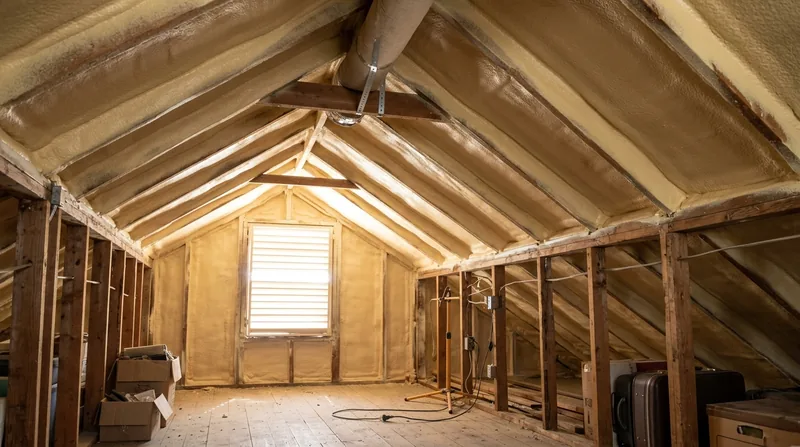




Lincoln's attics run hot and unforgiving in summer, then lose heat fast when winter wind sweeps across Lancaster County. Homes built from the early 1900s through today, from Havelock bungalows to newer subdivisions on the south and east edges of town, all face the same problem: attics that leak air, trap heat, and drive cooling and heating bills higher than they should be. Attic spray foam insulation in Lincoln seals those leaks and holds the temperature where it belongs, cutting the load on your air conditioner in July and your furnace in January. We spray closed cell or open cell foam directly onto the roof deck or attic floor, seal every penetration and rim, and stop the hot air and cold drafts that fiberglass never touches. The result is a conditioned attic that works with your HVAC system instead of against it, and a utility bill that reflects the real value of your home.
Why Attic Spray Foam Insulation Matters in Lincoln's Climate
IECC zone 5A heating and cooling swings put real stress on attic cavities. Summer sun bakes the roof deck to 160 degrees or higher, and that heat radiates down through fiberglass batts and blown-in cellulose into the rooms below. In winter, warm air from your living space rises into an uninsulated or poorly sealed attic, condenses on the cold roof sheathing, and soaks the framing and insulation. Vapor drives inward during humid summers and reverses outward in dry winters, so the attic becomes a moisture trap that shortens the life of rafters, trusses, and sheathing. Spray foam stops this cycle by sealing air leakage at the source and creating a vapor-resistant barrier that lets the roof deck stay closer to outdoor temperature in summer and keeps warm, humid air out in winter.
- Block summer heat gain by 40 to 60 percent when the attic is sealed to the roof deck instead of vented to the outside.
- Eliminate cold drafts and thermal bridges that pull heat from upper-floor rooms and bedrooms in winter.
- Stop moisture accumulation on roof sheathing and framing by controlling vapor movement and reducing air infiltration.
- Reduce the run time and cycling of your HVAC system, which extends equipment life and cuts maintenance costs.
- Create a conditioned attic that can safely store items without heat damage or mold risk.
Attics in Country Club, Havelock, and the newer subdivisions south of Lincoln all show the same failure pattern: rooms that are too hot or too cold, utility bills that climb year after year, and sheathing that shows moisture stains or soft spots where the roof has been leaking air and water vapor for years.
Key info: Lincoln sits in IECC climate zone 5A, which means heating dominates the energy load but cooling demand is rising. The attic is the single largest source of heat loss in winter and heat gain in summer. According to the U.S. Department of Energy, sealing and insulating the attic is one of the highest-ROI energy upgrades a homeowner can make. For more on energy code and attic ventilation rules that apply in your city, check your local building department's website or call (531) 229-1733 to discuss what applies at your address.
How We Spray Foam Your Attic: Step by Step
Every attic is different. A Havelock bungalow with original rafter bays needs a different approach than a mid-century ranch with a trussed roof or a new subdivision home with an unfinished attic space. We start with a site visit to measure the attic, identify air leaks, check for existing insulation, and determine whether the substrate is dry and ready to spray. If old insulation, moisture, or contamination is present, we remove it first. Then we set up mechanical ventilation, mask off any areas that need protection, and spray the foam to the specified thickness and R-value. After cure (24 to 48 hours depending on foam type), we check the installation, address any thin spots, and walk you through the results and re-entry timeline.
- We visit your home, measure the attic, and assess the condition of existing insulation, roof deck, and framing.
- We provide a written estimate that specifies the R-value, foam thickness in inches, and the total square footage to be sprayed.
- If removal is needed, we haul out old insulation, verify the substrate is dry, and check for any roof or plumbing leaks that must be fixed first.
- We set up mechanical ventilation and air scrubbers to manage VOCs during the spray and cure period.
- We spray the foam in controlled passes, maintaining the correct drum temperature and mix ratio for the product.
- We cure the foam per manufacturer spec, then trim excess and verify thickness and coverage across the entire attic.
- We remove ventilation equipment, clean up, and provide you with documentation of the work and a re-entry window.
A typical attic in a Lincoln rancher or subdivision home takes one day to spray and one day to cure and trim. Larger attics or homes with complex rafter layouts may take longer. We work around your schedule and provide a realistic timeline before we start.
Local example: A 1,400-square-foot attic in a Near South Lincoln home with existing blown-in cellulose and moisture stains took two days total: day one for removal and prep, day two for foam spray and initial cure. The homeowner re-entered after 48 hours and saw an immediate drop in the upstairs bedroom temperature during cooling season. The estimate included R-38 closed cell foam at 2.5 inches, which gives thermal and moisture control in one pass. Learn more about closed cell spray foam and when it's the right choice for your attic.
Attic Spray Foam Methods and Approaches
| Approach | Description | Best for |
|---|---|---|
| Closed Cell Spray Foam | High-density foam (1.5 to 2.0 lb/cu ft) with closed cells that resist air and water vapor. Requires 2 to 3 inches for R-15 to R-21 per inch of thickness. Creates a vapor barrier and structural reinforcement. | Attics with moisture risk, vented attics that need to become conditioned, retrofit jobs where space is tight, metal buildings and barndominiums. |
| Open Cell Spray Foam | Low-density foam (0.5 lb/cu ft) with open cells that allow vapor diffusion. Requires 5 to 7 inches for R-19 to R-25 per inch of thickness. Lower cost than closed cell and provides sound dampening. | Attics with no moisture concerns, homes where budget is primary, sound control in rooms below the attic (home theater, bedrooms). |
| Sealed Roof Deck | Spray foam applied directly to the underside of the roof deck, creating a conditioned attic that becomes part of the building envelope. Air sealing at all penetrations is critical. | New construction, major attic renovations, homes where attic space will be finished or used for storage, climate zones with high humidity. |
| Attic Floor Insulation | Spray foam applied to the attic floor (top of ceiling) instead of the roof deck. Creates a sealed floor plane and keeps the attic space unconditioned. Simpler than roof deck spray in retrofit scenarios. | Retrofit attics with no plans to finish or use the space, homes where roof deck access is difficult, budget-conscious projects. |
Attic Spray Foam Insulation Cost in Lincoln: What to Expect
Attic spray foam pricing in Lincoln typically starts at $1.50 per square foot for open cell foam on an attic floor and rises to $2.50 to $3.50 per square foot for closed cell spray foam on a sealed roof deck. The total cost depends on the attic size, the type of foam, the R-value you need, whether existing insulation must be removed, and the complexity of the roof structure. A 1,200-square-foot attic with open cell spray foam at R-25 might run $1,800 to $2,200 installed. A sealed roof deck with closed cell foam at R-21 in the same attic could run $3,000 to $4,200. Labor, equipment, and material all factor in, and every attic is different.
The best way to know what your attic will cost is to get a written estimate that spells out the R-value, the foam thickness in inches, the square footage, and the total price. We provide that for free at (531) 229-1733. Never accept an estimate with no R-value and no thickness specified. That is a red flag for a job that will not meet code or your expectations. Also ask whether the price includes removal of existing insulation, air sealing at penetrations, and trim work. Some contractors quote a low per-square-foot rate and then add removal, travel, and trim as line items that push the final bill much higher.
If your attic already has sound insulation and you just need a top-up to reach current code, blown-in fiberglass or cellulose might be the right answer and a lower cost than spray foam. We will tell you that honestly. See our full pricing page for more detail on what moves the cost up or down, and call us to discuss your specific job.
What to Look for When Hiring a Spray Foam Insulation Contractor Near Lincoln
The spray foam market in Lincoln and across Greater Nebraska has two extremes: rig-and-run crews that pull up in an out-of-state trailer, spray an attic in an afternoon, and disappear when the smell will not go away or the foam settles, and national franchises that operate the same way across 40 states with no local accountability. A local independent shop with a local address, local plates, and a phone number that rings in Lincoln is held to a different standard. Here is what to verify when you call any contractor, including us.
- Ask for proof of insurance and verify the policy covers spray foam application and the liability limits are adequate (minimum $1 million general liability).
- Get at least two or three written estimates that include R-value, foam thickness, square footage, and a total price with no hidden line items.
- Ask how long the contractor has been in business and whether they handle their own work or subcontract to out-of-state crews.
- Request references from recent jobs in Lincoln or nearby towns and call them to ask about smell during cure, cleanup, and whether the foam settled or developed gaps.
- Confirm that the estimate addresses whether your attic needs ventilation (soffit vents, ridge vents) or whether it will be sealed to code as a conditioned space.
- Ask about the re-entry window and whether mechanical ventilation will be used during cure to manage VOC levels.
- Verify the contractor understands your local building code and has worked with your city's building department on permit requirements.
Permitting and contractor registration rules vary from Lincoln to Waverly to Eagle to Hickman, and there is no reciprocity between cities. Always ask your local building department what applies at your address, and confirm that your contractor is familiar with those rules. Contact us to discuss your attic and get a free, no-obligation estimate with all the details spelled out. We have been in business since 2012, we are fully insured, and we work in Lincoln and the surrounding areas with local crews and local accountability.
Attic Spray Foam Insulation in Lincoln: Pricing Guide
| Service | Price | Details |
|---|---|---|
| Open Cell Spray Foam, Attic Floor | Starting at $1.50/sq ft | R-19 to R-25 in 5 to 7 inches, lower cost option, attic remains unconditioned, no removal included |
| Closed Cell Spray Foam, Sealed Roof Deck | Starting at $2.50/sq ft | R-15 to R-21 in 2 to 3 inches, vapor barrier included, attic becomes conditioned, moisture control premium |
| Insulation Removal and Replacement | On estimate | Cost depends on volume of existing insulation, disposal, and substrate condition; always quoted separately |
| Air Sealing and Penetration Closure | Included in foam price | Sealing of roof penetrations, electrical boxes, and ductwork is part of the spray foam installation scope |
| Travel and Setup | Included | No separate mileage or travel fee for jobs in Lincoln and surrounding Lancaster County area |
| Free Written Estimate | Free | Includes R-value, thickness, square footage, and total price; response within 24 hours at (531) 229-1733 |
Indicative pricing, the exact cost depends on square footage, finish, and site access. Free personalized estimate within 24h at (531) 229-1733.


