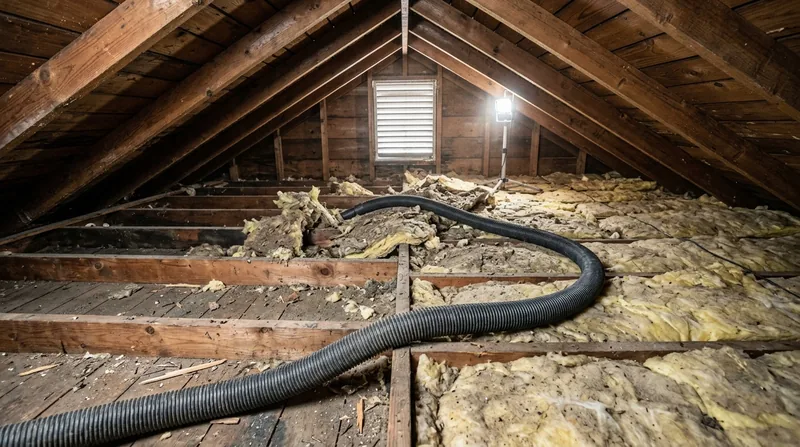




Old attic insulation in Havelock and Near South homes often hides decades of settled dust and moisture damage. We clear it out completely so new foam has a clean, dry surface in attics and basements across Lancaster County. Lincoln's housing stock spans a century, from original rafter bays over early-1900s bungalows to trussed roofs on newer subdivisions rising on the south and east edges of town. Nearly every home sits over a full basement, and in IECC climate zone 5A, those basements and their rim joists stay damp and cold through Nebraska's windy, snow-heavy winters. When old fiberglass, cellulose, or failed spray foam sits undisturbed for decades, it compacts, absorbs moisture, and stops working. Insulation removal in Lincoln is the first step before any retrofit. We remove the failed material completely, inspect the cavity for moisture and contamination, and prepare a clean, dry substrate for new foam. The result is a properly sealed attic, crawl space, or wall cavity that actually performs.
Why Insulation Removal Matters in Lincoln's Older Homes
Homes built before 1990 in Lincoln's Near South, Country Club, and Havelock neighborhoods were rarely insulated to modern standards. Many were blown in with cellulose or fiberglass that has settled, compacted, and absorbed moisture over decades. Some have deteriorated foam from earlier retrofit attempts. When you layer new spray foam over degraded insulation, you trap moisture and create a failed assembly that costs money to heat and cool without delivering the R-value you pay for. Removing the old material first is not optional, it is foundational.
- We extract all old insulation, blown-in material, and debris from attics, crawl spaces, and wall cavities before any new work begins.
- We inspect the cavity for moisture damage, mold staining, and structural issues that must be addressed before foam goes down.
- We vacuum and brush clean all dust, fibers, and contaminants so new spray foam bonds to a sound substrate.
- We dispose of all removed material responsibly according to Lancaster County and City of Lincoln waste guidelines.
A clean cavity and a verified dry substrate are the only foundation that makes new insulation work as promised. See our full attic spray foam insulation service to understand what comes after removal.
Key info: Many homes in Eagle and Ceresco built in the 1970s and 1980s have fiberglass that has settled to half its original thickness. Moisture from summer humidity and winter condensation has locked into the fibers. Removal and replacement with closed cell spray foam stops the cycle and cuts heating costs in winter when rim joists and band joists are coldest.
For guidance on what your building code requires, contact the City of Lincoln Building Department before any insulation work begins.
How We Remove Insulation and Prepare Your Space in Lincoln
Insulation removal is a multi-step process that requires containment, ventilation, and proper disposal. We do not simply bag up old material and leave dust in your home. We set up negative air flow, remove material systematically, clean the cavity, inspect for moisture and pests, and document the condition before any new work is quoted or begun. The process takes longer than a quick haul-out, but it is the only method that protects your home and ensures new foam will perform.
- We set up containment and negative air pressure equipment to prevent dust and fibers from spreading into living spaces.
- We remove all old insulation material, carefully extracting it from attic rafter bays, crawl space joists, and wall cavities.
- We inspect the cavity for moisture staining, mold, pest droppings, or structural damage that requires attention before new foam.
- We vacuum and brush the entire surface clean to remove dust, fibers, and debris that would interfere with foam adhesion.
- We verify the substrate is dry and sound, and document the cavity condition for your records and the new insulation estimate.
Once the cavity is clean and dry, we can accurately measure square footage and thickness, then quote the cost of closed cell or open cell spray foam tailored to your space and budget.
Example: A Havelock bungalow with 1,200 square feet of attic space covered in settled cellulose typically takes 8 to 12 hours to remove completely. A crawl space under a Waverly home with compacted fiberglass and moisture staining may take 6 to 10 hours. We quote removal time on site after inspecting access and contamination level.
Insulation Removal Methods and Best Use Cases
| Approach | Description | Best for |
|---|---|---|
| Vacuum Extraction with Containment | Blown-in fiberglass or cellulose is vacuumed into a sealed collection bin with negative air pressure to prevent dust escape into the home. | Attics, crawl spaces, and wall cavities in occupied homes where dust control is critical. |
| Manual Removal and Bagging | Batts, rolls, or deteriorated foam are carefully pulled out by hand, placed in heavy-duty bags, and sealed for disposal. | Rim joists, band joists, and wall cavities where vacuum access is limited or material is fragmented. |
| Mechanical Breakdown and Removal | Failed spray foam or rigid boards are broken down into manageable pieces and extracted manually or with small equipment. | Attics or crawl spaces with failed closed cell foam from prior installations or damaged rigid insulation. |
| Full Cavity Cleaning and Inspection | After material removal, we vacuum, brush, and inspect all surfaces for moisture, contamination, and structural soundness before new foam. | All removal jobs, mandatory before any new insulation is installed to ensure proper substrate and adhesion. |
Every removal job includes full cavity cleaning and inspection. The method chosen depends on the material type, cavity access, and whether moisture or contamination is present. We assess on site and explain the approach before work begins.
Insulation Removal Cost in Lincoln: What to Expect
The cost of insulation removal in Lincoln depends on the square footage of the cavity, the type of material being removed, accessibility, and whether moisture or contamination is present. A straightforward attic removal with settled fiberglass starts at $950 for a typical 1,000 to 1,200 square foot space. Crawl spaces, wall cavities, and spaces with moisture damage or difficult access cost more because they require additional time, containment, and inspection. We provide a free written estimate after a site visit, with no obligation to proceed.
Factors that affect removal cost include the total square footage of insulation to remove, the type of material (blown-in fiberglass costs less to remove than compacted cellulose or failed foam), the depth and density of the material, and the ease of access for equipment and crew. A one-story Havelock home with an attic accessible from a pull-down stair costs less to clear than a two-story home requiring scaffolding or a multi-level crawl space. Moisture damage or pest contamination adds inspection and disposal time. Getting 2 to 3 written estimates from contractors in your area ensures you understand the real cost and what is included in each quote.
See our full pricing page for a complete breakdown of removal costs and what each tier includes. Call (531) 229-1733 for a free estimate tailored to your home and space.
What to Look for When Hiring an Insulation Removal Contractor Near Me in Lincoln
Not all insulation removal contractors are equal. Some are one-man operations with a truck and a vacuum; others are national franchises with no local accountability. The best local contractor in Lincoln and Lancaster County is fully insured, can show proof of coverage, provides a detailed written estimate with square footage and removal method specified, and stands behind the work if issues arise after the job is done. Before you hire, verify that any contractor you consider can explain the removal method, show references from recent jobs in your neighborhood, and answer questions about moisture inspection and substrate preparation without pressure to book immediately.
Ask each contractor for proof of insurance, a written estimate that breaks down labor, disposal, and any contingencies, and references from at least two homes in Lincoln or surrounding areas. Verify they understand local permit requirements if your city requires notification before removal work begins. Some HOAs in master-planned subdivisions in south Lincoln may have rules about exterior work on metal buildings or sheds, so check your HOA documents before scheduling. The cheapest estimate is often a sign of a crew that cuts corners on containment, cleanup, or inspection. The most expensive is not always the best either. Choose a contractor who explains the process, answers your questions directly, and provides a timeline in writing.
Call us at (531) 229-1733 or request a free estimate. We provide a written quote within 24 hours, inspect your space thoroughly, and explain what we find before any work begins.
Insulation Removal in Lincoln: Pricing Guide
| Service | Price | Details |
|---|---|---|
| Attic Insulation Removal (1,000-1,200 sq ft) | Starting at $950 | Blown-in fiberglass or cellulose extraction with containment, cleanup, and cavity inspection included |
| Crawl Space Insulation Removal | Starting at $1,200 | Manual removal, moisture inspection, and full cavity cleaning with additional time for access and ventilation setup |
| Wall Cavity or Rim Joist Removal | Starting at $600 | Targeted removal of failed foam or batts from specific cavities, inspection, and substrate prep for new foam |
| Multi-Zone or Contaminated Removal | On estimate | Moisture damage, pest droppings, or failed foam across multiple zones requires site inspection before cost is quoted |
| Travel | Included | in Lincoln and surrounding areas, no separate mileage fee or call-out charge |
| Free Estimate | No charge | Written quote within 24 hours, (531) 229-1733, no obligation to book or proceed |
Indicative pricing, the exact cost depends on square footage, finish, and site access. Free personalized estimate within 24h at (531) 229-1733.


