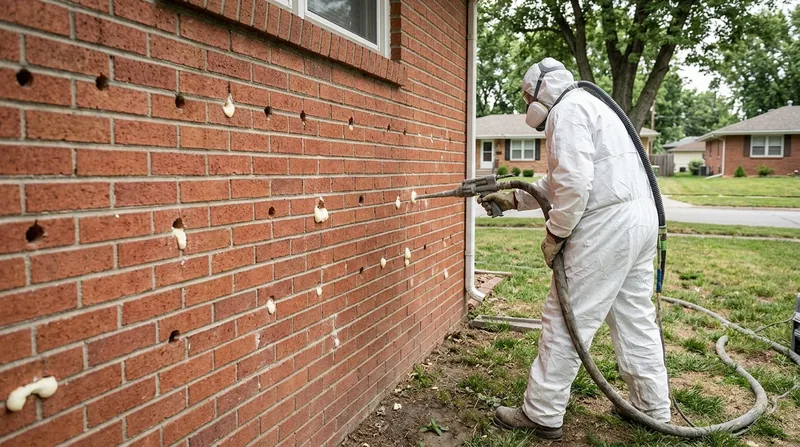




Lincoln's mid-century ranches and older homes scattered through Lancaster County were built without wall insulation, leaving homeowners with cold winters and high heating bills. Wall and injection foam insulation fills those closed cavities without tearing open drywall, making it the practical retrofit for the thousands of 1950s and 1960s ranches that dominate the city's residential stock. Unlike attic or basement work, wall injection happens from the outside or through small drill holes, preserving your interior finishes while sealing the thermal envelope. If you own one of Lincoln's uninsulated mid-century homes or a rental property with poor wall performance, injection foam delivers R-value where it matters most, without the cost and mess of demolition. We've been doing this work across Lancaster, Saunders, and Otoe counties since 2012, and we know exactly which homes need it and how to do it right.
Why Wall Injection Foam Matters in Lincoln's Uninsulated Housing Stock
Most of Lincoln's mid-century ranches were framed and sided with no insulation in the wall cavities. Fiberglass batts were not standard until the 1970s, and even then, builders skipped walls in many neighborhoods. That means your heating and cooling system works overtime trying to condition a home with almost no thermal barrier in the walls. Winter wind pushes through the cavity, and summer heat radiates straight through the exterior. Injection foam solves this without opening up the drywall.
- Fills closed cavities in solid-wall construction without demolition or drywall removal.
- Expands to seal air gaps and thermal bridging that fiberglass never reaches.
- Works in retrofit applications where access is limited and speed matters.
- Improves heating efficiency immediately in homes that have never had wall insulation.
- Reduces drafts and cold spots on exterior walls in winter, the dominant failure mode in Lincoln's climate.
Getting wall insulation into a 1950s ranch is one of the highest-return energy upgrades you can make in this region. Check your local building department's energy code requirements at Lincoln Planning and Zoning to confirm what applies to your property before you start.
Key info: Lincoln's older neighborhoods like Havelock and the Near South sit on full basements with rim joists that leak cold, but the walls above are the real energy drain in winter. A 1960s ranch with no wall insulation can lose 25 to 40 percent of its heating energy through those cavities, especially on the north and west sides where wind pressure is highest.
How We Install Wall Injection Foam in Lincoln Homes: The Process
Wall injection foam starts with a site visit to map the cavity structure, identify stud spacing, and confirm the cavity is dry and free of contamination. We drill small access holes (typically 1.5 to 2 inches) in a pattern that ensures complete fill. The foam is injected under low pressure into each cavity, expanding to fill voids and air gaps. Once cured, the holes are patched and the wall is sealed. The whole process happens from the outside or interior, depending on access and your preference.
- We inspect the wall cavity with a thermal camera or borescope to confirm it is dry before foam goes in.
- Drill access holes are placed strategically to ensure even fill and complete coverage of the cavity.
- Foam is applied at the correct ratio and pressure, with mechanical ventilation during cure to manage any off-gassing.
- Holes are sealed with matching caulk or foam plugs, and the wall is returned to its original appearance.
- Re-entry time is 24 to 48 hours, after which the wall is fully cured and ready for use.
A typical single-story ranch wall retrofit takes one to two days, depending on the square footage and cavity accessibility. We handle everything from insulation removal if old fiberglass is present, to the final patch and paint coordination.
Example: A 1,200-square-foot Havelock ranch with 2x4 frame walls and no insulation typically takes two days to inject and cure. We drill from the exterior siding, fill all four sides of the house, and patch the holes to match the siding. The homeowner sees an immediate drop in heating bills and no cold drafts by the following winter.
Wall Injection Foam Methods and Materials
| Approach | Description | Best for |
|---|---|---|
| Open Cell Injection Foam | Lower density, softer, breathable foam that expands to fill cavities. Cures quickly and allows vapor to move through the wall. | Interior walls, non-structural applications, and retrofit jobs where cost matters more than maximum R-value per inch. |
| Closed Cell Injection Foam | Higher density, rigid foam with superior R-value per inch and vapor control. Resists moisture and air infiltration more aggressively. | Exterior walls, walls with moisture risk, and homes where maximum thermal performance is the goal despite higher cost. |
| Partial Cavity Fill | Foam injected to a target R-value (often R-15 to R-21) rather than completely filling the cavity, leaving air space above. | Budget-conscious retrofits and walls where full fill is not necessary to meet energy code or performance goals. |
| Full Cavity Fill | Foam fills the entire cavity from bottom plate to top plate, maximizing R-value and air sealing. | Premium retrofit jobs, homes with severe drafts, and properties where maximum thermal and air-sealing performance justifies the cost. |
The choice between open cell and closed cell depends on your wall orientation, moisture risk, and budget. North and west-facing walls in Lancaster County see more wind-driven rain and temperature swing, so closed cell is often the safer choice. South and east walls can perform well with open cell at a lower cost. We discuss both options during your free estimate and recommend based on your home's specific exposure.
Wall and Injection Foam Insulation Cost in Lincoln: What to Expect
Wall injection foam in Lincoln typically starts at $2 to $3 per square foot for open cell partial fill on interior walls, and runs $3 to $5 per square foot for closed cell full cavity fill on exterior walls. A typical 1,200-square-foot ranch with four exterior walls and 8-foot ceilings (about 3,840 square feet of wall surface) falls in the $7,500 to $15,000 range depending on foam type, cavity fill depth, and access. The biggest cost drivers are foam type (open cell is cheaper, closed cell performs better), whether you fill the entire cavity or stop at a target R-value, and the complexity of drilling access (siding type, architectural details, and obstruction). Travel to Lincoln and surrounding areas is included, and we provide a detailed pricing breakdown once we've assessed your walls on site.
Always get two or three estimates before committing. A written estimate should specify the foam type, target R-value, square footage, and the number of access holes. If an estimate is vague about R-value or thickness, or quotes a price far below market with no inspection, that is a red flag. We charge $0 for an estimate and respond within 24 hours at (531) 229-1733. Our estimate includes a thermal assessment of the wall, a recommendation on foam type and fill depth, and a firm price with no surprises.
What to Look for When Hiring a Wall and Injection Foam Contractor Near Lincoln
Wall injection foam is a precision job, and the difference between a good install and a bad one shows up in heating bills and indoor comfort. Verify that any contractor you hire carries full insurance, provides written estimates with R-value and thickness specs, and can explain the difference between open cell and closed cell foam without pushing you toward the more expensive option just because. Ask for references from homes in Lincoln or nearby Lancaster County neighborhoods, and ask specifically about re-entry time, any odor issues after 48 hours, and whether the homeowner would hire them again. Permitting for wall insulation is minimal in most Lincoln neighborhoods, but confirm with your local building department if your home is in a historic district or HOA that governs exterior work. Get everything in writing before work starts, including the foam type, R-value target, access hole locations, and the patch and paint plan.
- Confirm full insurance coverage and ask to see the certificate before any crew arrives on your property.
- Request a written estimate that names the foam type, R-value, square footage, and cavity fill strategy.
- Check references from at least two homes in Lincoln or nearby towns where the contractor has done injection work.
- Ask how the contractor ensures the cavity is dry before foam goes in, and what happens if moisture is found.
- Clarify the re-entry window, who handles patching and paint, and what warranty applies to the foam and the installation.
- Verify that the contractor uses a insured crew with the equipment to apply foam at the correct ratio and pressure.
If you have questions about permits or want to verify what applies to your specific address, contact us or reach out to the City of Lincoln Planning and Zoning office. We help homeowners navigate the rules so the job is done right the first time.
Wall & Injection Foam Insulation in Lincoln: Pricing Guide
| Service | Price | Details |
|---|---|---|
| Open Cell Injection Foam, Partial Fill | Starting at $2/sq ft | Interior or lower-exposure walls, open cell foam to R-15 or R-18 target, budget-friendly retrofit option for mid-century ranches |
| Closed Cell Injection Foam, Partial Fill | Starting at $3/sq ft | Exterior walls, closed cell foam to R-18 to R-21 target, superior moisture resistance and R-value, better for north and west exposures |
| Full Cavity Fill, Closed Cell | Starting at $4 to $5/sq ft | Complete fill from bottom to top plate, maximum thermal and air-sealing performance, premium retrofit for homes with severe drafts |
| Complex or multi-story retrofit | On estimate | Two-story homes, multiple cavity types, difficult siding, or existing contamination require site assessment before pricing |
| Travel and Estimate | Included and Free | No mileage fee in Lincoln and surrounding Lancaster County, free written estimate within 24 hours, no obligation to book |
Indicative pricing, the exact cost depends on square footage, finish, and site access. Free personalized estimate within 24h at (531) 229-1733.


