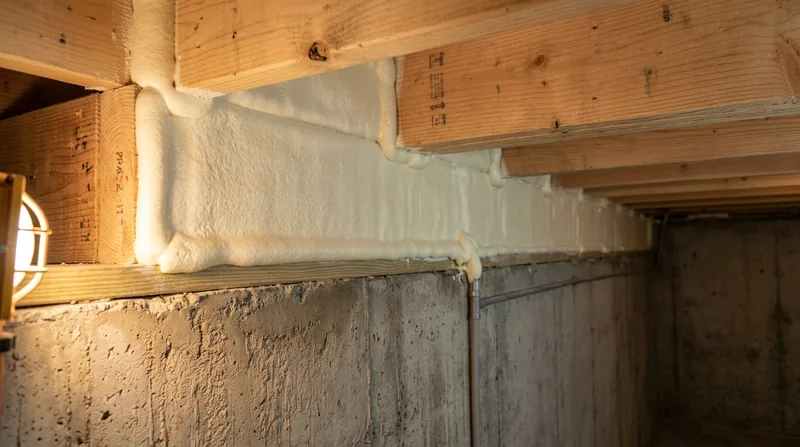




Rim Joist & Band Joist Spray Foam in Lincoln stops the cold draft that settles into every full basement across Lancaster County each winter. The rim joist, or band joist, is the wooden frame that sits on top of your foundation wall and anchors your home's floor system. In Lincoln's climate zone 5A, that band joist stays exposed to ground moisture in summer and bitter wind-driven cold in winter, making it one of the fastest routes for heat loss and infiltration in any basement. We spray foam that gap to seal the air leaks, stop the moisture swing, and cut the chill that drives up your heating bill from November through March. A properly sealed rim joist also prevents the condensation that collects there during humid summers and the drafts that make basement rooms and spaces above garages uncomfortable year-round. This is a straightforward, high-impact retrofit that works in older Havelock bungalows, mid-century ranches, and newer subdivisions alike.
Why Rim Joist & Band Joist Spray Foam Matters in Lincoln's Basements
Every full basement in Lincoln and Lancaster County sits on a foundation wall, and every foundation wall has a rim joist running around its top edge. That wood frame is the thermal bridge between your heated basement or the floor above it and the cold soil outside. In Lincoln's windy winters, air leaks through gaps in the rim joist, around rim board fasteners, and where the sill plate meets the concrete. Ground moisture moves upward through the concrete in spring and summer, then evaporates into the rim joist cavity, wetting the wood and its insulation. Spray foam seals those air leaks and stops the moisture from migrating into the wood, protecting both your comfort and the structural integrity of the frame.
- Stops cold drafts that settle into basements and rooms above garages during Nebraska winters.
- Breaks the thermal bridge between your home's interior and the cold foundation perimeter.
- Seals air leaks around rim board fasteners, sill plates, and concrete-to-wood transitions.
- Controls moisture vapor that moves into the rim joist from the surrounding soil and air.
- Prevents the condensation that collects on band joists during humid summers.
A sealed rim joist is the first step in making a cold basement warmer and drier, and it is one of the most cost-effective energy retrofits in any home.
Key info: Lincoln's older neighborhoods in the Near South and Country Club districts have rim joists that have never been insulated. Mid-century ranches scattered through the county and newer subdivisions on the south and east edges all sit over full basements with the same thermal and moisture challenge. If your basement feels cold in winter or damp in summer, your rim joist is almost certainly the culprit.
For more detail on how moisture and air infiltration affect your home's energy performance, see our guide to air sealing in Lincoln.
How We Seal Your Rim Joist: The Process in Lincoln
Rim joist spray foam is a straightforward retrofit that we handle from the basement side. We inspect the rim board, sill plate, and the concrete-to-wood junction for air gaps, moisture, and existing insulation. If the area is wet or shows active moisture, we stop and recommend addressing the moisture source first. Once the substrate is dry, we apply closed cell or open cell spray foam to seal the cavity, stop air leaks, and create a vapor barrier that controls moisture movement. The foam expands to fill gaps around fasteners, electrical penetrations, and the rim board itself, creating a continuous thermal and air seal. We then trim the foam flush or slightly proud of the rim board and inspect the installation for coverage and thickness.
- We inspect the rim joist and sill plate for gaps, moisture, and existing insulation condition.
- We verify the concrete and wood are dry before we apply any foam to the substrate.
- We apply spray foam in controlled passes to achieve the specified R-value and thickness.
- We seal gaps around fasteners, electrical boxes, and plumbing penetrations as part of the continuous air seal.
- We trim excess foam and inspect the final installation for complete coverage and even thickness.
The entire process typically takes one to two hours for a standard basement perimeter, and the foam cures within 24 to 48 hours before the space can be fully occupied.
Real example: A 1950s ranch in Lincoln's southeast quadrant had a cold basement and high winter heating bills. The rim joist was bare wood with gaps around the sill plate and no insulation. We sealed the rim joist with 2 inches of closed cell foam, achieving an R-13 thermal barrier. The homeowner reported warmer basement temperatures and lower heating costs within the first winter.
For details on how we approach air sealing throughout your home, visit our crawl space spray foam page, which covers similar moisture and air sealing principles.
Rim Joist & Band Joist Spray Foam Methods: Closed Cell vs. Open Cell
| Approach | Description | Best for |
|---|---|---|
| Closed Cell Spray Foam | Dense, rigid foam with R-value of 6 to 7 per inch. Acts as air barrier and vapor retarder. Resists moisture and does not absorb water. | Rim joists in basements with high moisture risk or where vapor control is critical. Standard choice for foundation perimeter sealing. |
| Open Cell Spray Foam | Softer, semi-rigid foam with R-value of 3.5 to 4 per inch. Allows vapor to diffuse through the foam. Lighter and less expensive per board foot. | Rim joists in drier basements or where vapor permeability is preferred. Less common for rim joists but used when cost or vapor dynamics favor it. |
| Foam Thickness | Typically 2 to 3 inches of closed cell (R-13 to R-21) or 3 to 4 inches of open cell (R-11 to R-16). Thickness is determined by rim board depth and energy target. | Standard rim joists 7 to 10 inches deep can accommodate 2 to 3 inches of foam. Shallower rims may limit thickness; deeper rims can take more. |
| Existing Insulation Removal | If the rim joist already has fiberglass, mineral wool, or failed foam, we remove it before applying new foam. Substrate must be clean and dry. | Any retrofit where old insulation is present, wet, or compromised. Removal ensures full contact between new foam and the rim board. |
Closed cell is the standard choice for rim joists in Lincoln because it resists moisture and provides superior vapor control in our humid summers and damp springs. Open cell may be considered in specific cases where dryness is assured and cost is the primary driver, but we typically recommend closed cell for foundation perimeter work.
Rim Joist & Band Joist Spray Foam Cost in Lincoln: What to Expect
Rim joist spray foam typically starts at $650 for a standard basement perimeter in Lincoln. The final cost depends on several concrete factors: the linear feet of rim joist to be sealed, the depth and condition of the rim board, whether existing insulation must be removed, and access to the rim joist from the basement side. A small ranch with a 120-foot perimeter will cost less than a larger two-story home with a 180-foot perimeter. If the rim joist is already wet or shows moisture damage, we address the moisture source first, which may add cost or delay the foam installation. A written estimate that specifies the R-value, foam thickness in inches, and total board feet is the only honest way to price this work.
- Linear feet of rim joist to be sealed is the primary cost driver for this work.
- Removal of existing insulation or debris adds time and material handling to the bid.
- Access constraints or tight rim board cavities may increase application difficulty and cost.
- Moisture remediation or drying time before foam application may be required and will be quoted separately.
We always provide a free, written estimate with R-value and thickness specified. Call us at (531) 229-1733 or visit our pricing page for more detail on how we structure estimates for rim joist and other spray foam work.
Rim Joist & Band Joist Spray Foam Near Me: What Lincoln Homeowners Should Know When Hiring
When you are looking for a spray foam insulation contractor near Lincoln to seal your rim joist, the most important step is to get multiple written estimates that include R-value, foam thickness in inches, and total square footage or board feet. Any contractor who quotes a price without specifying these details is cutting corners. Ask to see proof of insurance, and verify that the contractor can explain why closed cell or open cell is the right choice for your specific basement conditions. If your home was built before 1980 or sits in a historic district, check whether permits are required in your city for insulation work. Finally, ask about the re-entry window after application. Honest contractors will tell you 24 to 48 hours; anyone promising immediate occupancy is taking risks with curing and off-gassing.
- Request a written estimate that names R-value, foam thickness, and coverage area in square feet or board feet.
- Verify that the contractor is fully insured and can provide a current certificate of insurance.
- Ask whether your city or neighborhood HOA requires permits or architectural approval for insulation work.
- Confirm the curing time and re-entry window before the space can be occupied or used normally.
- Check references from recent rim joist or basement insulation jobs in Lincoln or Lancaster County.
We are fully insured and provide free estimates within 24 hours. Call (531) 229-1733 or contact us online to schedule your no-obligation inspection and estimate.
Rim Joist & Band Joist Spray Foam in Lincoln: Pricing Guide
| Service | Price | Details |
|---|---|---|
| Standard rim joist sealing | Starting at $650 | Includes inspection, foam application to achieve R-13 or R-21, and trim for a typical basement perimeter up to 150 linear feet |
| Larger or complex perimeter | Starting at $950 | Homes over 2,000 square feet or rim joists with obstacles, existing insulation removal, or moisture drying time required first |
| Existing insulation removal | Starting at $200 | Removal and disposal of failed fiberglass, mineral wool, or old foam before new spray foam application can begin |
| Travel and setup | Included | No separate mileage or travel fee within Lincoln and surrounding Lancaster County service areas |
| Free written estimate | Free | Response within 24 hours at (531) 229-1733, includes R-value and thickness specs, no obligation to book |
Indicative pricing, the exact cost depends on square footage, finish, and site access. Free personalized estimate within 24h at (531) 229-1733.


